
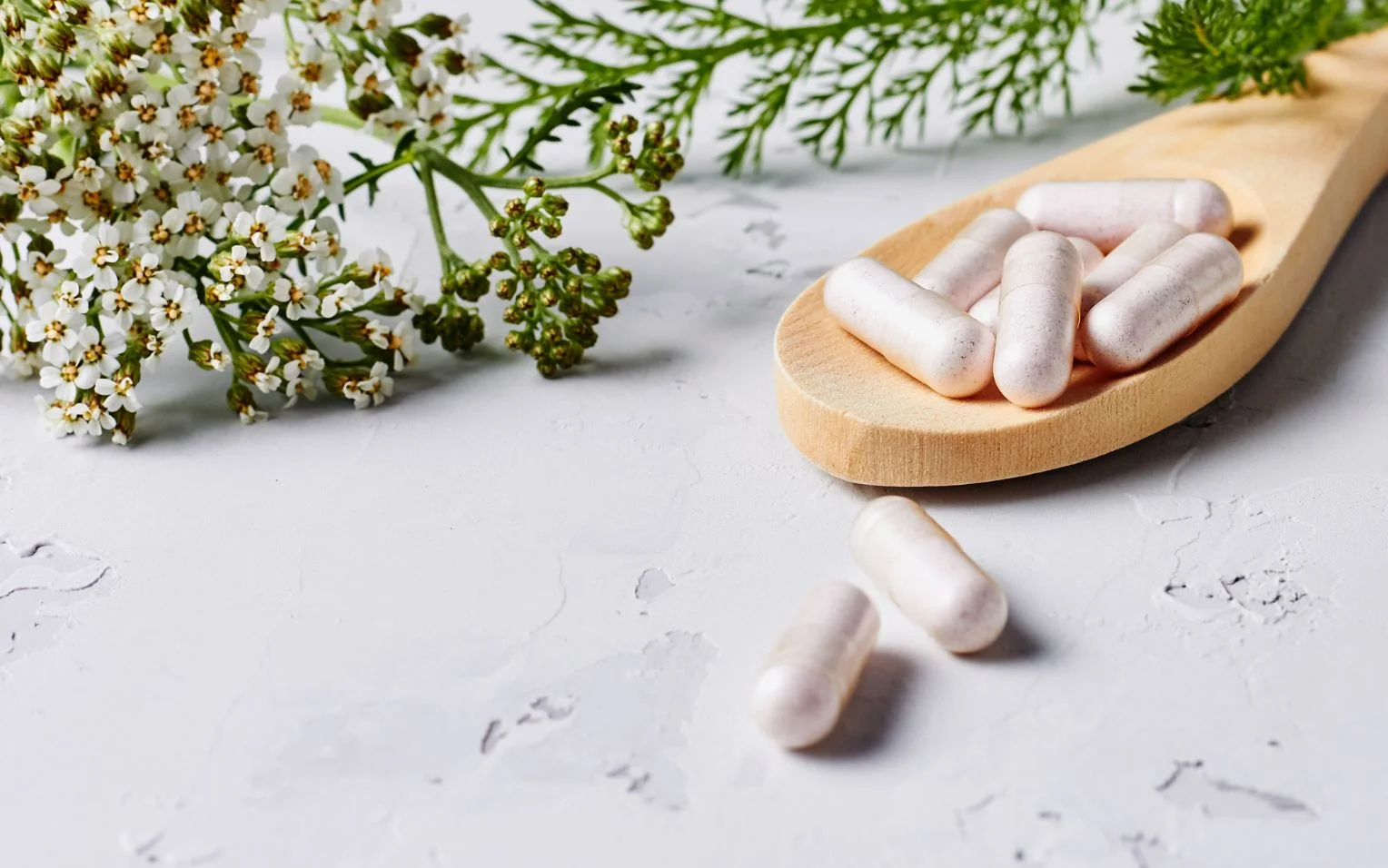
I get asked this a lot: Do you believe in supplements?
Yes. I do. And I actually find it a little bizarre when people don’t — because supplements literally supplement what is lacking in your body that you need. That’s it. That’s what they do.
Medication targets symptoms. Supplements — along with diet and lifestyle — target the root. And when you address what’s actually going on underneath, your body can do what it already knows how to do. This is what Whole Person Health looks like.
What I typically see with the women I work with though, is that they are taking supplements. They’re just not taking enough.
Most women aren’t reaping the benefits of supplementation because they’re taking a general dose — whatever’s printed on the back of the bottle. And that dose is designed for maintenance. It’s a baseline. When your body is in metabolic debt — when your blood sugar is elevated, when your insulin is working overtime, when your numbers aren’t moving down — a general dose isn’t going to get you where you need to go. You’re thinking supplements don’t work, but you’re not taking enough. You need a therapeutic dose.
Here’s a perfect example: berberine. The bottle usually says 500mg, twice a day. But the research consistently supports 500mg three times daily for meaningful metabolic support — taken before meals. That’s the therapeutic range. When your body needs help, you meet it where it is.
So if you need metabolic support — whether you’re managing high blood sugar, insulin resistance, or weight that just won’t respond — these are the 7 supplements I recommend having in your wellness cabinet, and why each one matters.
1. Berberine
I love Berberine. Berberine activates an enzyme called AMPK — sometimes called your body’s “metabolic master switch” — which helps regulate how your body uses energy, processes glucose, and responds to insulin. It supports healthy fasting blood sugar, may help improve insulin sensitivity, and has been shown to support healthy cholesterol and triglyceride levels too. It’s one of the most well-researched natural compounds for metabolic health, and it’s a staple in my practice and pantry.
What to know: The therapeutic dose for metabolic support is typically 500mg three times daily, taken before meals. Start lower and work your way up over a month — to give your digestive system time to adjust (will cause constipation otherwise).
2. Citrus Bergamot
Citrus bergamot is a Mediterranean citrus fruit — and its extract is remarkable for cardiovascular and metabolic support. It’s rich in polyphenols that support healthy cholesterol ratios (lowering LDL while raising HDL), help reduce triglycerides, and may support healthy blood sugar levels. For women in midlife, where metabolic and cardiovascular risk factors tend to overlap, this one does a lot of heavy lifting.
What to know: Look for a standardized extract. The research supports 500–1,000mg daily, taken before meals.
3. Digestive Bitters
If you’re not breaking down and absorbing your food properly, your body can’t use the nutrients you’re giving it — no matter how well you eat. Digestive bitters stimulate your body’s own production of digestive enzymes, stomach acid, and bile. They support the entire process of breaking food down so that what you eat actually serves you. Better digestion also means better blood sugar response after meals.
What to know: Take bitters about 15 minutes before your main meals. A few drops on the tongue or diluted in a small amount of water.
4. Fiber
You’ve heard it before, but I’ll say it differently: fiber is one of the most underused tools for blood sugar management. Soluble fiber slows the absorption of glucose into your bloodstream, which helps prevent those post-meal spikes that drive insulin resistance over time. It also feeds the beneficial bacteria in your gut — and your gut health has a direct line to your metabolic health. Most women are getting about half the fiber they actually need in a day.
Put simply: we need to obsess over fiber as much as we do for protein.
What to know: If you’re supplementing, start slow and increase gradually. Psyllium husk, acacia fiber, and ground flaxseed are all solid options. Take with plenty of water.
5. Green Tea Extract
Green tea extract is concentrated in a compound called EGCG, which has been studied for its ability to support fat metabolism and improve insulin sensitivity. It helps your body use glucose more efficiently and may support healthy weight management — especially in the context of insulin resistance, where your body tends to store rather than burn. It also has anti-inflammatory and antioxidant properties, which matters when inflammation is one of the root cause drivers keeping your numbers stuck.
What to know: Look for a standardized extract with a known EGCG content. If you’re sensitive to caffeine, choose a decaffeinated version.
6. Organic Whey Protein
Protein at every meal is one of the foundational principles of the Whole GI Protocol™, and a high-quality whey protein makes that easier — especially at breakfast, which is where most women fall short. Whey protein helps stabilize blood sugar by slowing gastric emptying and supporting a more even insulin response. It also supports lean muscle, which is critical for metabolic health in midlife because muscle is where your body processes glucose. The vanilla makes it genuinely enjoyable — in smoothies, mixed into oatmeal, or blended with coffee.
What to know: Choose organic, grass-fed whey with minimal ingredients. You want protein, not a chemistry experiment. If you’re dairy-sensitive, a clean plant-based protein can work here too — just make sure it’s not loaded with sweeteners or fillers.
7. Probiotic
Your gut microbiome plays a much bigger role in blood sugar regulation than most people realize. The bacteria in your gut influence how you metabolize glucose, how your body responds to insulin, and even how you store fat. A high-quality probiotic supports that ecosystem — and when your gut is functioning well, everything downstream works better. Digestion improves. Inflammation decreases. And your body becomes more responsive to the food and supplements you’re giving it.
What to know: Look for a multi-strain probiotic with a high CFU count (colony-forming units). Refrigerated options tend to be more potent. And if you’re also taking berberine, which has its own gut-modulating effects, a probiotic helps maintain balance.
One More Thing
These seven supplements can do remarkable things for your metabolic health. But for you to live a full, long, healthy life — one where you are truly free from disease — your supplements and your medications (if you’re taking any) need to stack on top of a foundation.
That foundation is a healthy diet. A healthy lifestyle. Connection with your body — and with the people you love. It’s rest. It’s movement that feels good. It’s deep and healing sleep. It’s laughter and sunlight and doing things that bring you joy.
The supplements support the foundation. They don’t become the foundation.
So yes — take the supplements. Build your wellness cabinet. Get your therapeutic doses dialed in. And also: go for the walk. Cook the meal with someone you love. Sit outside for ten minutes with your coffee and breathe. That is Whole Person Health. All of it, together.
with care,
Jen Polk, I.N.H.C
IIN Certified Health Coach (Institute for Integrative Nutrition) | Founder, Well + Easy | Integrative Nutrition Practitioner specializing in low glycemic nutrition, insulin resistance, and metabolic health for women. Read my professional bio here
References
Yin, J., Xing, H., & Ye, J. (2008). Efficacy of berberine in patients with type 2 diabetes mellitus. Metabolism, 57(5), 712–717. PubMed
Lee, Y.S., et al. (2006). Berberine, a natural plant product, activates AMP-activated protein kinase with beneficial metabolic effects in diabetic and insulin-resistant states. Diabetes, 55(8), 2256–2264. Diabetes Journals
Pérez-Rubio, K.G., et al. (2013). Effect of berberine administration on metabolic syndrome, insulin sensitivity, and insulin secretion. Metabolic Syndrome and Related Disorders, 11(5), 366–369. PubMed
Mollace, V., et al. (2019). Clinical application of bergamot (Citrus bergamia) for reducing high cholesterol and cardiovascular disease markers. Integrative Food, Nutrition and Metabolism, 6(1). PMC
Cai, Y., et al. (2017). Effects of 12-week supplementation of Citrus bergamia extracts-based formulation CitriCholess on cholesterol and body weight in older adults with dyslipidemia. Lipids in Health and Disease, 16(1), 251. PMC
Takeuchi, T., et al. (2023). Gut microbial carbohydrate metabolism contributes to insulin resistance. Nature. Referenced in: Gut microbiome regulates inflammation and insulin resistance. Signal Transduction and Targeted Therapy (2024). Nature
Tonucci, L.B., et al. (2020). Probiotics supplementation and insulin resistance: a systematic review. Diabetology & Metabolic Syndrome, 12, 98. PMC
As always, please consult your healthcare provider before starting any new supplement, especially if you are currently taking medication or managing a diagnosed condition. This article is for educational purposes and does not constitute medical advice.